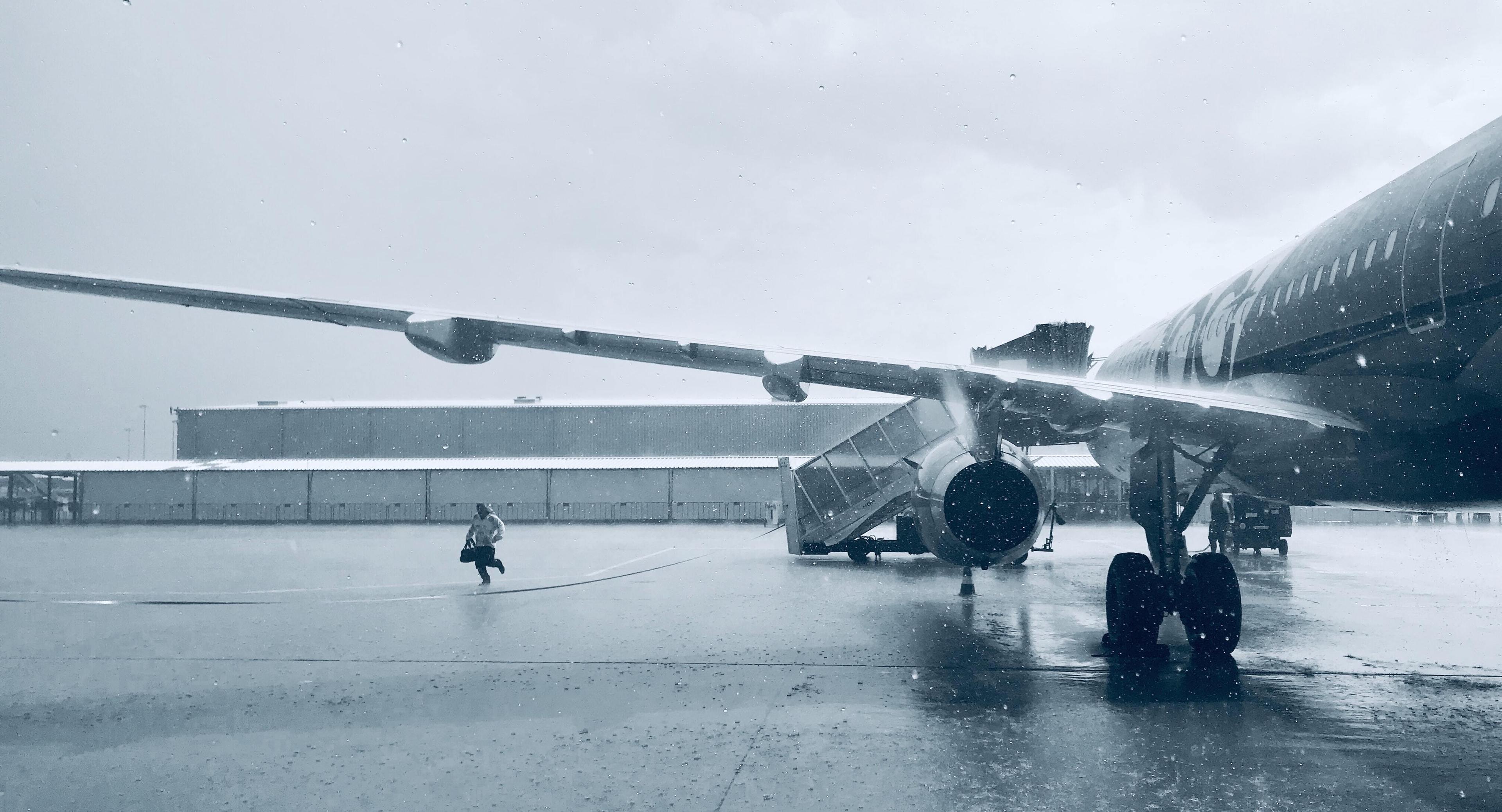

For most of commercial aviation's history, the cockpit has had no access to truly live, continuously updated weather information. Crews departed with the best forecast their dispatcher could assemble on the ground, and whatever weather they encountered en route was theirs to deal with alone. Apart from text-based METAR or SIGMET updates via ACARS, nothing else came in. Geostationary satellite systems carried enough capacity for text messages, but not for streaming live, high-resolution atmospheric data throughout a flight.
That is now changing. Low-earth orbit constellations, led by Starlink, deliver the throughput and latency that make continuous in-flight data streaming viable for the first time. The Electronic Flight Bag is evolving from a pre-flight briefing tool into a live data interface, posing a question the industry is only now beginning to understand: what becomes possible when high-resolution weather data flows into the cockpit continuously, throughout the flight? The short answer: it depends entirely on the quality of the data being streamed.
What High-Throughput Connectivity Makes Possible
A Shared Operational Picture
The most immediate consequence of high-throughput in-flight connectivity is straightforward: when the flight crew’s EFB, the operations control center, and the dispatch desk all query from the same data source (same model, same resolution, same refresh cadence), a conversation about an en-route deviation becomes genuinely collaborative. This matters because weather decisions are rarely made in isolation. A rerouting request involves ATC, dispatch, and the flight deck simultaneously. A hold-for-fuel decision involves the destination’s forecast, the alternate’s availability, and the aircraft’s precise fuel state at ETA - none of which can be reasoned about well when different participants are working from different versions of the atmosphere. Shared data does not guarantee good decisions, but it removes a handicap the industry has quietly accepted as normal.
The deeper consequence, however, is more significant. It goes well beyond screen-sharing a forecast: the emergence of AI agents operating in real time on live meteorological data.
The AI Agent in the Loop
The architecture for this has become dramatically more accessible. The Model Context Protocol (MCP) - an open standard that lets AI models call external tools and data services directly - means that a language model can now query a weather API, retrieve thunderstorm and wind forecasts along a specific route, cross-reference them against aircraft certification limits, and surface a recommendation, all within a single reasoning loop. The agent does not simply retrieve data; it interprets it in context. It knows the flight level, the aircraft type, the alternate options. When the atmosphere changes, it re-runs that reasoning and flags the change to the crew, to the dispatcher, or to both.
Illustrative agent scenarios:
- Dynamic rerouting: An agent monitors convective growth along the filed route and proposes a deviation before the crew would need to request it from ATC.
- Destination fuel decisions: Fog probability at the arrival airport, updated in real time against the ETA, feeds directly into a revised alternate fuel recommendation.
- Delay anticipation: Ground delay probability at the arrival airport, integrated with weather trend data, surfaces earlier than ATFM slot notifications typically arrive.
- Turbulence awareness: EDR values across flight levels, queried live, enable proactive step climbs rather than reactive ones based on reports from preceding aircraft.
None of these scenarios require science fiction. They require weather data with sufficient resolution and latency to be acted on in real time, an integration layer that can be called from an agent reasoning loop, and connectivity that keeps the airborne terminal online throughout the flight. All three of those components now exist. The most demanding of them - and the one that determines how well the others perform - is the weather data itself.
The Data That Makes It Work
Resolution
Not all weather data is fit for every operational purpose. Broad-grid global models, the backbone of aviation weather products for decades, are adequate for cruise-altitude planning, but far less useful for the decisions that most directly affect safety margins and schedule performance: the convective cell developing 30 nm off the planned route, the radiation fog settling over the destination as the aircraft passes the top of descent. Capturing those events requires resolution in both space and time that coarse-grid models were never designed to deliver.
Forecast failures in aviation are almost always resolution failures: the atmosphere described too coarsely, and too far in the past.
A 1 km grid refreshed multiple times per day gives operators something a 25 km model updated every few hours cannot: turbulence expressed as EDR values across all vertical levels, fog probability that evolves minute by minute, convective categories that distinguish between benign cumulus and a cell with genuine hail potential. The operational difference is between acting on the actual state of the atmosphere and acting on a two-hour-old generalization of it.
Speed
Resolution alone is not enough - the data also needs to arrive fast enough for agent reasoning loops to be useful. A query resolving in milliseconds across 1,800 available parameters - wind at any flight level, contrail probability, freezing level height, route-segment icing - allows agents to treat atmospheric state as a live input rather than a cached snapshot. That response time is what separates a truly reactive system from one that merely looks reactive because the refresh interval is short enough to mask the lag.
What Gets Built Next
The aviation industry has long been cautious about introducing new data into the cockpit, and that instinct is well-founded. The goal here is not to flood flight crews with more information, but to give them better information - when it is relevant, at the moment it matters - and enable them to make better decisions.
This is precisely the design problem that AI agent-based systems are suited to address, not by flooding the crew with outputs, but by absorbing the monitoring task and escalating only when the atmospheric state has changed in a way that warrants attention. The agent watches. The crew decides. The division of labor is the point.
The next few years will see EFB platforms evolve from digital document holders into live operational nodes, connected to the same data environment as the (I)OCC, capable of hosting agent logic that watches the atmosphere throughout the flight and surfaces the right information before anyone has to ask for it. The airlines and operators that get ahead of this shift will not just have better weather products, they will have a fundamentally different relationship between information and decision.
The cockpit is, for the first time, genuinely connected to the live data environment surrounding it. What gets built on that foundation is the question the industry now needs to answer.